3 Things That Are Not Going To Happen in Today's Housing MarketThere’s a lot of uncertainty right now and that’s leading to some dramatic headlines. And if you’re thinking about

Dated: May 22 2024
Views: 85

Are big investors really buying up all the homes today?
If you’re trying to find a house to buy, this may be something you’re wondering about. Maybe you’ve read about it or seen reels on social media saying investors buying all the homes is making it even harder to find what the average buyer is looking for. But spoiler alert – there’s a lot of misinformation out there. To clear things up, here's the scoop on what's really happening. A lot of the big investor activity is actually in the rearview mirror already.
The Wall Street Journal (WSJ) explains:
“Investors of all sizes spent billions of dollars buying homes during the pandemic. At the 2022 peak, they bought more than one in every four single-family homes sold, though more recently their activity has slowed as interest rates rose and supply became tighter.”
The key here is investor activity has slowed significantly, and even during the peak of investor buying, 3 out of every 4 single-family homes purchased were by regular, everyday buyers – not investors. And of the investors who bought over the past few years, most weren’t the big investors you may be hearing about. The vast majority were small mom-and-pop investors – people like your neighbors who own only a couple of homes, maybe even just their main residence and a vacation home.
But let’s focus on the giant, mega-investor firms since that's what is being talked about so frequently on social media right now. Mega investors are those who own 1,000+ properties. You may be surprised to see that, according to the Wall Street Journal, they don’t buy all that many homes (see graph below):
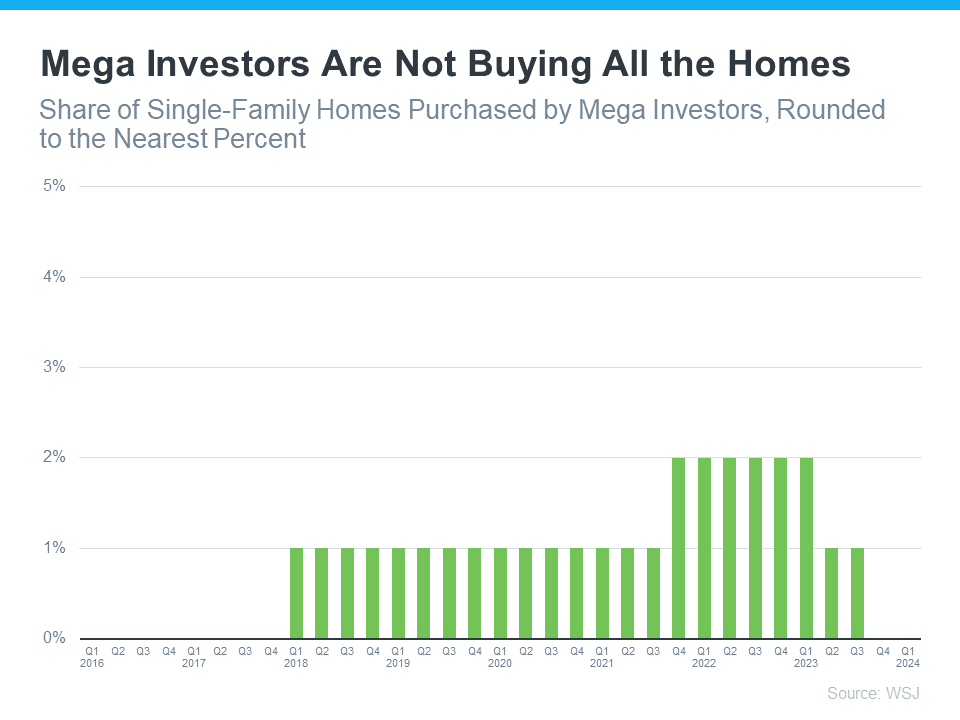
This graph tells us two things. First, institutional investors were never buying a large percentage of available homes. During the peak in 2022, they bought about 2% of available single-family homes. Second, that percentage has gotten even smaller recently (so small the number rounds down to 0%).
In an effort to understand why that percentage is trending down, private lender RCN Capital asked investors about the challenges they’re facing. Here’s what Jeffrey Tesch, CEO of RCN Capital, found out:
“Investors are already facing many challenges in today’s housing market – rising prices, limited inventory, and higher financing costs.”
Understanding these challenges is important because they show big, mega investors aren’t taking over the housing market.
So, don't fall for everything you hear. They aren't snatching up all the homes and making it impossible for regular people to buy.
Big investors aren’t buying all the homes out there. If you've got questions about what you're hearing about the housing market, let's chat. I can help you understand what's really going on.

Hi there! Are you thinking about buying or selling a home in Southern California? I'm a licensed real estate sales associate and Notary Public. With many years of experience under my belt, I've he....
3 Things That Are Not Going To Happen in Today's Housing MarketThere’s a lot of uncertainty right now and that’s leading to some dramatic headlines. And if you’re thinking about
Top 3 Reasons To Buy a Home Before SpringIf you’re planning to buy a home this year, you may be focused on the spring market. And hoping that when spring does hit, you’ll see:Mortgage
The Housing Market Is Turning a Corner Going into 2026After several years of high mortgage rates and hesitation from buyers, momentum is quietly building beneath the surface of the housing market.
Why Buyers and Sellers Face Very Different Conditions TodayThere’s a new divide in housing right now. In some states, buyers are gaining ground. In others, sellers still have the upper hand.
 Based on information from California Regional Multiple Listing Service, Inc. as of September 23, 2026 10:07 PM UTC This information is for your personal, non-commercial use and may not be used for any purpose other than to identify prospective properties you may be interested in purchasing. Display of MLS data is usually deemed reliable but is NOT guaranteed accurate by the MLS. Buyers are responsible for verifying the accuracy of all information and should investigate the data themselves or retain appropriate professionals. Information from sources other than the Listing Agent may have been included in the MLS data. Unless otherwise specified in writing, Broker/Agent has not and will not verify any information obtained from other sources. The Broker/Agent providing the information contained herein may or may not have been the Listing and/or Selling Agent.
Based on information from September 23, 2026 10:07 PM UTC The information being provided by CRMLS is for the visitor's personal, noncommercial use and may not be used for any purpose other than to identify prospective properties visitor may be interested in purchasing. The data contained herein is copyrighted by CRMLS, CLAW, i-Tech MLS, PSRMLS and/or VCRDS and is protected by all applicable copyright laws. Any dissemination of this information is in violation of copyright laws and is strictly prohibited.
Any property information referenced on this website comes from the Internet Data Exchange (IDX) program of CRMLS. All data, including all measurements and calculations of area, is obtained from various sources and has not been, and will not be, verified by broker or MLS. All information should be independently reviewed and verified for accuracy. Properties may or may not be listed by the office/agent presenting the information.
